Detention pay isn’t a gray area. It’s written into most rate confirmations, expected by brokers, and charged by the vast majority of carriers. Yet somehow, most detention pay never actually gets collected.
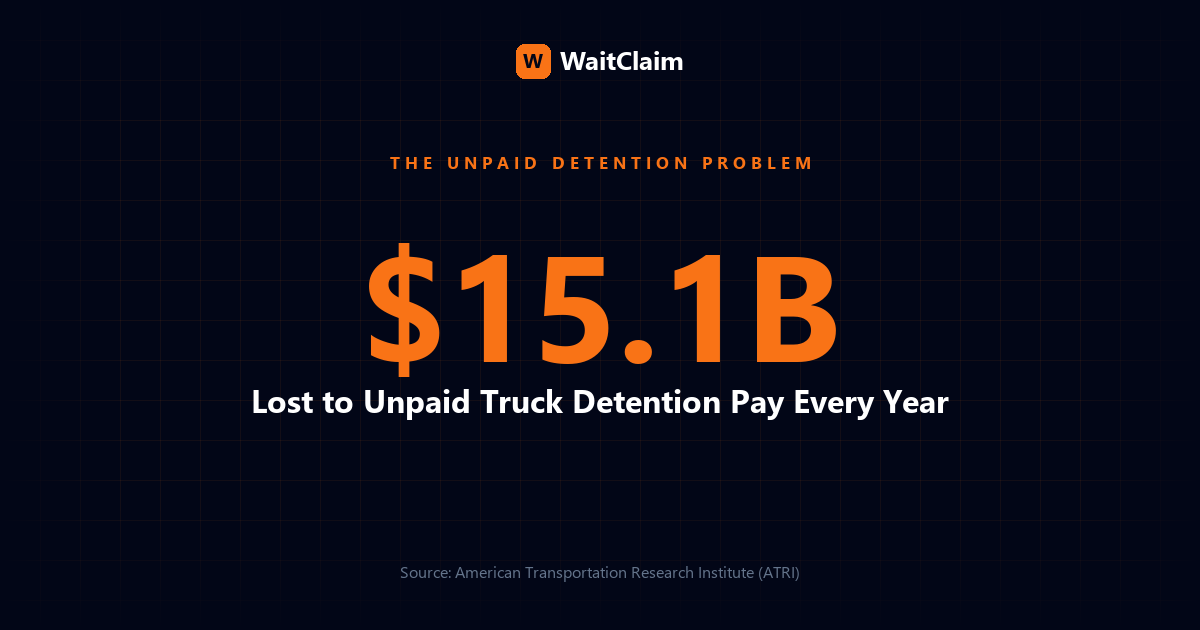
According to the American Transportation Research Institute (ATRI), 94.5% of fleets charge detention when a driver is held past free time at a shipper or receiver — but fewer than half of those detention pay invoices actually get paid. Industry-wide, that gap adds up to an estimated $15.1 billion a year, absorbed almost entirely by the drivers sitting in the parking lot, not the companies that caused the delay.
So why doesn’t detention pay just get paid?
It’s not that brokers refuse to honor detention pay on principle. In most cases, they simply don’t have a reason to trust the claim. A text to dispatch saying “I was here 4 hours” or a time scrawled on a Bill of Lading is easy to dispute and even easier to just ignore — especially when a broker is juggling hundreds of loads a week and the squeaky wheel gets the follow-up.
The drivers who do get paid consistently tend to have one thing in common: they can prove exactly when they arrived, exactly when they left, and they don’t have to re-explain it every time.
What actually gets detention pay collected
Three things separate a detention pay claim that gets paid from one that gets ignored:
- A timestamp nobody can argue with. GPS-verified arrival and departure times carry more weight than a handwritten note, because there’s no ambiguity about when the clock started.
- Consistent math. Free time, rounding rules, and rate all need to be applied the same way every time — brokers are far more likely to pay a detention pay claim that matches how they already calculate it internally.
- Speed. An invoice sent same-day, while the load is still fresh in everyone’s memory, gets paid more often than one filed a week later after the paperwork finally gets sorted.
Most drivers who eat detention pay aren’t wrong about being owed the money — they just don’t have the time to build a case for every single stop.
Collecting detention pay doesn’t have to be complicated
This is exactly the gap WaitClaim was built to close: a 1-tap GPS check-in at arrival, a 1-tap check-out at departure, and a detention pay invoice that’s already built — timestamped, rounded correctly, and ready to send — by the time you pull out of the lot.

If detention pay has been quietly eating into your weekly revenue, it’s worth doing the math on what it’s actually costing you. Try the calculator to see the number for your own week, or head straight to how the whole thing works.